
Introduction
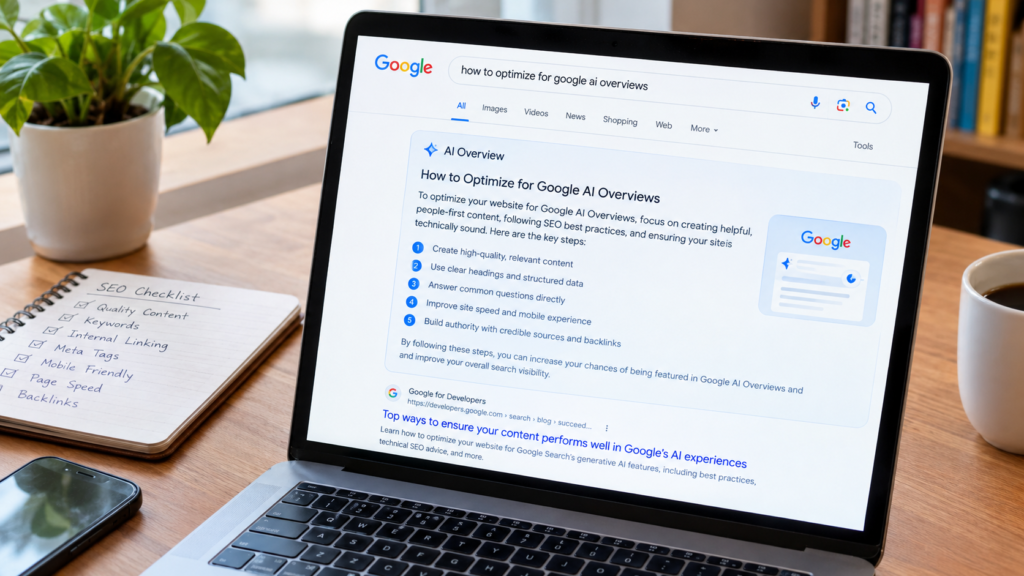
Search engines are evolving, and Google AI Overviews are changing how people discover information online. Instead of showing only traditional search results, Google can display an AI-generated summary with links to relevant webpages for certain searches.
For website owners, bloggers, and digital marketers, this creates another opportunity to reach people who are looking for useful answers. However, simply adding AI-related keywords or publishing AI-generated articles does not guarantee visibility in these results.
Google AI Overviews optimization means making your website useful, accessible, and easy to understand while following established SEO best practices. The goal is to provide accurate information that helps users solve their problems.
In this guide, you will learn how Google AI Overviews work, which SEO improvements matter, how to structure your content, and how to measure your website’s performance.
What Are Google AI Overviews?
Google AI Overviews are AI-generated summaries that can appear in Google Search for certain queries. They bring together information to help users understand a topic and may provide links to webpages where they can explore it further.
For example, someone searching for “how to improve website SEO” may see an overview of useful SEO practices along with links to relevant sources.
AI Overviews do not appear for every search. Google determines when these experiences may be helpful, and the displayed information and links can vary by query.
For website owners, the practical goal is to create useful pages that Google can access, understand, and consider relevant to users’ questions.
Official resource: Google AI Features and Your Website
1. Start with Strong SEO Fundamentals
The first step in Google AI Overviews optimization is to make sure your website follows established SEO principles. Google explains that its AI search features rely on its existing Search systems and that there are no additional technical requirements specifically for appearing in AI Overviews.
Begin with these checks:
- Make sure important pages are accessible to Googlebot.
- Check that pages can be indexed when intended.
- Use descriptive page titles and headings.
- Create useful internal links between related pages.
- Make sure the website works well on mobile devices.
- Fix broken pages and important technical errors.
- Keep important information accurate and up to date.
You do not need a separate website or a special AI-only sitemap. Focus on making your existing website helpful to users and accessible to search engines.
Read Google’s SEO Starter Guide.
2. Create Helpful, Original Content
High-quality content is an important part of AI search optimization. Pages that simply repeat common information without adding meaningful value may struggle to stand out.
Instead of writing only to include keywords, answer the questions your audience genuinely wants to solve.
For example, a generic article about SEO might define search engine optimization. A more useful article could explain how a small business can check indexing, improve a service page, and measure organic search performance.
To improve your content:
- Explain topics accurately and clearly.
- Include practical examples and useful steps.
- Add original observations or experience when available.
- Support factual claims with trustworthy sources.
- Update information when it becomes outdated.
- Remove unnecessary repetition and filler.
Google recommends creating unique, valuable, people-first content for its AI search experiences. <Cite refs={[“turn789437search1″,”turn789437search16”]}/>
3. Answer Specific Questions Clearly
Users increasingly search with detailed questions rather than short keywords. Your website can serve these users by answering relevant questions directly.
For example, related queries for this topic may include:
- How do Google AI Overviews work?
- How can I optimize content for AI search?
- Does traditional SEO still matter for AI Overviews?
- Can structured data help Google understand my website?
- How can I track organic search performance?
Use relevant questions as headings when they fit your article. Follow each heading with a clear answer and then provide additional explanation, examples, or steps.
A useful structure is:
Question: Does SEO still matter for Google AI Overviews?
Direct answer: Yes. Google says that established SEO best practices remain relevant to its AI search experiences. Websites should focus on useful content, technical accessibility, and helping Google understand their pages.
This format improves readability, but no particular paragraph length or answer format guarantees inclusion in an AI Overview.
4. Use Clear Headings and Readable Formatting
Well-organized content helps visitors find information quickly. It also gives search engines clearer context about the topics covered on your page.
Follow a logical heading structure:
- H1: Main article title
- H2: Main sections
- H3: Supporting points within a section
Use short paragraphs where appropriate, numbered steps for processes, and bullet points for lists.
Avoid using headings only to repeat your focus keyword. Each heading should describe the information that follows.
For example, an article about Google AI Overviews could have sections about technical SEO, helpful content, keyword research, structured data, and performance tracking.
The aim is not to write for an AI system instead of a person. The aim is to make the content easier for everyone to understand.
5. Target Relevant Long-Tail Keywords
Long-tail keywords are more specific search phrases that often communicate a clear question or need.
For this topic, possible keyword ideas include:
- how to optimize for Google AI Overviews
- Google AI Overviews SEO best practices
- how AI search affects website SEO
- technical SEO for AI search
- how to improve content for Google AI search
- Google AI Overviews and organic traffic
These are suggested keyword ideas, not verified search-volume or ranking-difficulty figures. Check them using Google Keyword Planner, Google Trends, and Search Console where appropriate.
Choose keywords based on relevance to your audience. Avoid creating a separate article for every small variation of the same question if the pages would repeat the same information.
6. Make Your Website Easy to Crawl and Index
Even useful content may not appear in search results if Google cannot access or index the page.
Review these technical SEO elements:
Robots.txt: Check that important content is not unintentionally blocked from crawling.
Noindex directives: Make sure pages you want to appear in search are not accidentally marked noindex.
HTTP status: Important pages should load successfully rather than returning errors.
Internal links: Link relevant pages so visitors and search engines can discover them.
Canonical tags: Use appropriate canonical URLs when similar or duplicate URLs exist.
Mobile usability: Ensure important information and navigation work properly on mobile devices.
Google Search Console can help you identify indexing issues. Fix verified problems first, then inspect the affected URLs again.
Official resource: Google Search Technical Requirements
7. Use Structured Data Correctly
Structured data is code that helps search engines interpret information on a webpage. Depending on the page, relevant structured data may describe an organization, a local business, a product, or an article.
For example, an article may use appropriate Article structured data to help Google understand its headline, author, and publication information.
Remember these guidelines:
- Choose a structured data type that matches the page.
- Make sure the markup reflects the actual page content.
- Follow Google’s structured data policies.
- Validate the implementation with appropriate testing tools.
- Correct errors and misleading information.
Important: Adding schema does not guarantee that your page will appear in Google AI Overviews. Google does not require special AI schema for inclusion in these experiences.
Read Google’s Structured Data Guidelines.
8. Build Trust with Accurate Information and Expertise
Readers need to know whether the information on a website is reliable. Clear explanations, accurate facts, transparent authorship, and evidence of genuine experience can help establish trust.
Consider the following practices:
- Publish accurate and verifiable information.
- Identify the author when appropriate.
- Explain methods and recommendations clearly.
- Link to original sources for important factual claims.
- Update articles when relevant information changes.
- Include real examples or case studies when you have permission and evidence to share them.
Do not invent credentials, customer testimonials, statistics, or case studies to make an article appear authoritative.
For a digital marketing website, practical SEO examples and transparent explanations can be more useful than unsupported claims about guaranteed rankings.
9. Improve Images and Other Useful Media
People do not always search using text alone. Useful images and videos can help explain a topic and support the visitor’s understanding.
To improve media on your website:
- Use relevant, high-quality images.
- Add descriptive alt text to informative images.
- Use suitable image formats and file sizes.
- Include captions or context when useful.
- Add videos when they genuinely improve the explanation.
- Keep important text available as readable webpage content.
Avoid adding irrelevant images solely for SEO. Every visual element should contribute to the page’s purpose.
Google recommends supporting text with helpful visual content where appropriate for its AI search experiences. <Cite refs={[“turn789437search1″,”turn789437search16”]}/>
10. Measure SEO Performance and Improve Over Time
Google AI Overviews optimization should be part of a broader search strategy, not an isolated task.
Use Google Search Console to review:
- Organic search impressions and clicks
- Queries that bring visitors to your pages
- Page indexing and technical issues
- Changes in search performance over time
Google’s AI features do not require a separate special tracking setup for inclusion. Performance from AI features is included within Google’s overall Search reporting, rather than being guaranteed as a separate, fully isolated report for every AI Overview appearance.
You can also use Google Analytics to understand what visitors do after reaching your website, such as reading a service page or submitting an inquiry.
Measure meaningful results, not only rankings. For a business website, relevant leads and useful customer interactions can be more valuable than traffic that does not match your audience.
Useful tools:
Common Myths About Google AI Overviews Optimization
Myth 1: You need special AI schema to appear
Google does not require special AI-specific structured data to appear in AI Overviews. Use structured data where it is appropriate for the page and supported by Google’s guidelines.
Myth 2: Repeating a keyword more often improves AI visibility
Keyword stuffing is not a reliable strategy. Use natural language and focus on providing complete, relevant answers.
Myth 3: AI-generated articles automatically rank
Content quality and usefulness matter regardless of how content is produced. Automatically generated content that adds little value can perform poorly. Review content for accuracy, originality, and user benefit.
Myth 4: Ranking first guarantees an AI Overview citation
There is no guarantee that a page ranking first in ordinary search will be cited in an AI Overview. Inclusion and link selection depend on Google’s systems and the specific query.
Myth 5: You should ignore traditional SEO
Google’s official guidance says established SEO fundamentals remain relevant to its AI search features. Keep improving the website as a whole rather than chasing a separate set of supposed AI ranking tricks.
How Digital Janhavi Can Help Businesses Improve Online Visibility
Businesses need a useful website, clear service information, relevant content, and a practical SEO strategy to reach potential customers online.
Digital Janhavi offers digital marketing-related services, including SEO, website design, and content writing.
If you want to learn more, visit Digital Janhavi or explore its digital marketing services.
For businesses looking for an internet marketing agency in Varanasi, the right approach should depend on their audience, services, website condition, and marketing goals.
Frequently Asked Questions
What is Google AI Overviews optimization?
It is the process of improving your website’s content, accessibility, and overall SEO so Google can understand and consider relevant pages for its AI search experiences. It does not guarantee inclusion.
How do I optimize my website for Google AI Overviews?
Start with helpful and original content, clear headings, relevant answers, strong technical SEO, appropriate internal links, and accurate structured data where relevant. Monitor your website’s performance using Google Search Console.
Does Google require special schema for AI Overviews?
No. Google states that no additional technical requirements or special AI-specific optimizations are required for inclusion in AI Overviews. Structured data should be used when appropriate and implemented according to Google’s guidelines.
Does traditional SEO still matter for AI search?
Yes. Google explains that its AI search experiences build on its existing Search systems and that SEO fundamentals remain relevant.
Can small business websites appear in AI Overviews?
A small business website may be considered when its content is relevant and useful for a query. There is no guaranteed route to inclusion, so businesses should focus on helpful information and sound SEO practices.
Conclusion
Google AI Overviews are changing how people discover information, but successful optimization starts with familiar SEO fundamentals. Create original and useful content, answer relevant questions clearly, maintain a technically accessible website, and build trust with accurate information.
Avoid shortcuts and unsupported AI ranking tricks. Instead, improve the experience you provide to visitors and use performance data to guide your next steps.
A consistent, user-focused SEO strategy gives your website a stronger foundation for visibility in traditional Google Search and its evolving AI experiences.