
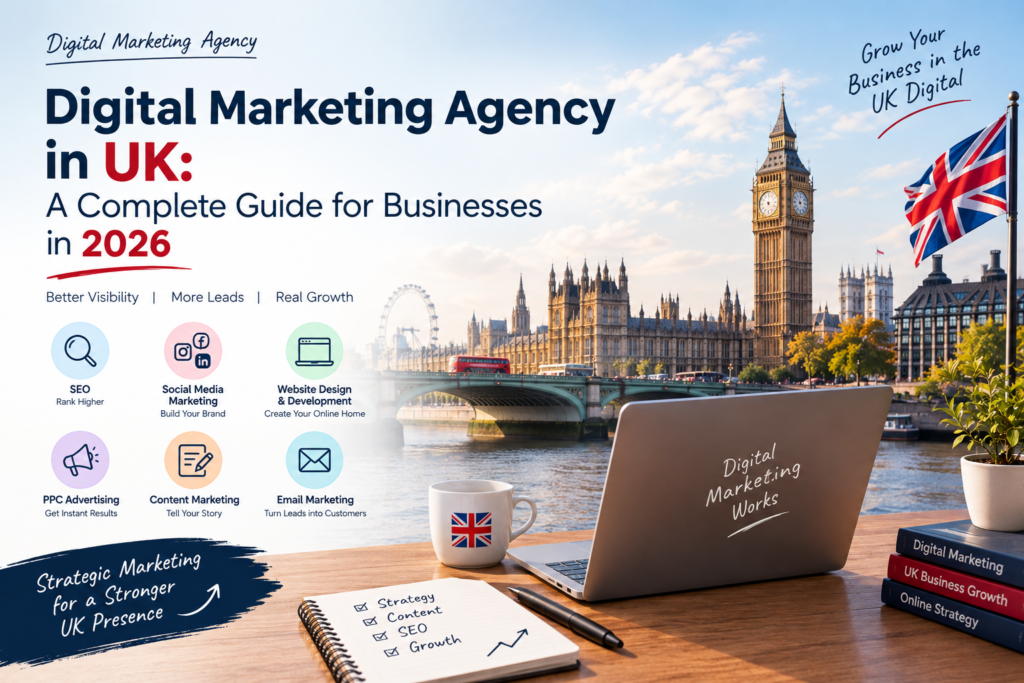
How to Choose a Digital Marketing Agency in the UK
Businesses across the United Kingdom are competing for attention online. Whether a company operates in London, Manchester, Birmingham, Leeds or another UK city, having a website is only the starting point. Businesses also need to reach the right audience, build trust and turn website visitors into enquiries and sales.
A Digital Marketing Agency in the UK can help businesses develop a practical online marketing strategy through search engine optimisation (SEO), paid advertising, social media marketing, content creation and website optimisation.
However, choosing an agency is not just about finding the cheapest package or the company promising the fastest results. The right partner should understand your target customers, business objectives, competition and budget.
In this guide, we will explore the services offered by UK digital marketing agencies, typical costs, how to choose a suitable provider and what businesses should consider before investing in digital marketing.
What Does a Digital Marketing Agency in the UK Do?
A digital marketing agency helps businesses promote their products or services through online channels. Instead of managing every marketing activity separately, a business can work with one team to plan campaigns, create content, improve search visibility and measure performance.
The exact services depend on the agency and the client’s requirements. Common services include:
-
- Search engine optimisation (SEO)
-
- Search engine marketing (SEM) and paid advertising
-
- Social media marketing (SMM)
-
- Website design and development
-
- Content writing and marketing
-
- Email marketing
-
- Conversion rate optimisation
-
- Analytics and performance reporting
For example, a local service business may need stronger Google visibility and more phone enquiries, while an e-commerce company may focus on product sales, shopping campaigns and repeat purchases.
The strategy should reflect the business objective rather than simply adding more marketing channels.
Why Is Digital Marketing Important for UK Businesses?
Customers often research businesses online before contacting a company or making a purchase. A useful website, relevant search results and consistent communication can help businesses become easier to discover and evaluate.
Here are some practical reasons to invest in digital marketing.
1. Reach the Right Audience
Digital campaigns can target audiences by location, search intent, interests and other relevant characteristics. This helps businesses focus their marketing on people who are more likely to need their products or services.
2. Improve Search Engine Visibility
SEO helps businesses make their websites easier for search engines and users to understand. Relevant pages, useful content, sound technical foundations and appropriate internal links all contribute to a stronger search strategy.
Google’s official SEO Starter Guide explains how websites can improve their presence in search results through helpful content and sound SEO practices.
3. Generate More Qualified Leads
A well-planned campaign should do more than attract website visitors. It should encourage suitable prospects to take meaningful actions, such as requesting a quote, completing an enquiry form or booking a consultation.
4. Measure Marketing Performance
Analytics can help businesses understand which channels generate traffic, enquiries and sales. This information makes it easier to identify weak campaigns and decide where to invest next.
5. Build Long-Term Brand Trust
Consistent branding, informative content, positive customer experiences and a professional website can help a business build credibility over time.
Essential Services Offered by a UK Digital Marketing Agency
The best service mix depends on your industry, target audience and growth objectives.
Search Engine Optimisation (SEO)
SEO helps a website attract relevant visitors from unpaid search results. It generally involves keyword research, on-page optimisation, technical checks, content improvements and relevant authority-building activities.
For UK businesses, local SEO can also help connect a company with customers searching for services in a particular town, city or service area.
SEO is a long-term investment. Results vary according to competition, website condition, content quality and the work required, so no responsible agency should guarantee a particular Google ranking.
Search Engine Marketing (SEM) and PPC Advertising
Paid search campaigns allow businesses to advertise for relevant search terms and direct potential customers to specific landing pages.
An agency may help with campaign structure, keyword selection, ad copy, conversion tracking and budget optimisation. The advertising budget should be considered separately from the agency’s management fee unless the proposal clearly states otherwise.
Social Media Marketing (SMM)
Social media marketing helps businesses build awareness, engage with their audience and promote products or services on appropriate platforms.
Typical activities include content planning, graphic design, short-form video, community management and paid social campaigns. Results depend on the quality of the content, audience fit and consistency.
Website Design and Development
A website should clearly explain what a business offers, why customers should trust it and what they should do next.
Professional website services may include responsive layouts, user-friendly navigation, landing pages, contact forms, technical SEO foundations and improvements to page speed.
A visually attractive website is valuable, but it should also make it easy for visitors to enquire, book or buy.
Content Writing and Marketing
Useful content answers customer questions and helps people make informed decisions. Depending on the business, this may include service pages, blog articles, product descriptions, case studies and email newsletters.
Content should be original, accurate and written for the intended audience rather than created solely to repeat keywords.
Email Marketing
Email marketing allows businesses to communicate with people who have chosen to receive their updates. Campaigns may include newsletters, product announcements, useful resources and customer follow-ups.
Businesses should obtain appropriate consent where required and follow applicable UK data protection and electronic marketing rules.
How Much Does a Digital Marketing Agency in the UK Cost?
Digital marketing costs in the UK vary considerably. Pricing depends on the services required, campaign complexity, business size, competition and amount of work included.
For example, published UK agency price lists show that entry-level local SEO or social media packages may cost a few hundred pounds per month, while more involved SEO, advertising and multi-channel campaigns can cost considerably more.
DPOM
+2
The following table is an illustrative planning guide, not a verified UK-wide average.
| Service | What affects the cost? |
|---|---|
| SEO services | Competition, technical work, content and link acquisition |
| PPC management | Campaign complexity, number of campaigns and reporting |
| Social media marketing | Platforms, content volume, design and video production |
| Website design | Number of pages, features and integrations |
| Content marketing | Research, article length, expertise and publishing frequency |
| Full digital marketing | Number of channels, workload and business goals |
Before agreeing to a package, ask the agency for a written breakdown of deliverables, management fees, advertising spend, reporting frequency and contract terms.
A lower price is not necessarily better value, and a higher price does not automatically mean better results.
How to Choose the Right Digital Marketing Agency in the UK
Choosing an agency requires more than comparing prices or looking at its website. You need a team that understands your business and can explain how its work will support your objectives.
Consider these factors before making a decision.
1. Review Relevant Experience
Look for experience with businesses similar to yours. An agency that understands e-commerce may have a different approach from one that primarily works with professional services or local businesses.
Ask for relevant case studies and examples of completed work.
2. Understand the Strategy
A professional agency should explain what it plans to do, why those activities matter and how success will be measured.
Be cautious of vague promises such as guaranteed first-page rankings or a fixed number of sales without understanding your business.
3. Check Reporting and Communication
You should know what work has been completed, what the results indicate and what the agency plans to improve next.
Reports should focus on meaningful metrics rather than presenting website traffic or social media followers without business context.
4. Compare Deliverables, Not Just Prices
Before signing a contract, check the number of articles, technical SEO tasks, advertising campaigns, creative assets and reporting sessions included in the package.
Also clarify ownership of your website, advertising accounts, analytics data and creative materials.
5. Look for a Long-Term Approach
Sustainable marketing involves testing, reviewing results and making improvements. An agency should be willing to adjust its strategy when customer behaviour or campaign performance changes.
How Does Digital Marketing Work for Different UK Businesses?
The right approach depends on what a business sells and how customers make purchasing decisions.
| Business type | Potential marketing priorities |
|---|---|
| Local service businesses | Local SEO, Google Business Profile and enquiry-focused landing pages |
| E-commerce stores | Product SEO, shopping campaigns and conversion optimisation |
| Professional services | Educational content, search advertising and lead generation |
| Start-ups | Brand positioning, focused campaigns and customer research |
| Established companies | Multi-channel campaigns, analytics and ongoing optimisation |
For instance, a plumbing business in Birmingham may prioritise local searches and phone enquiries. An online clothing store selling throughout the UK may need product-page optimisation, shopping ads and email marketing.
The important point is to select channels based on customer behaviour instead of trying to use every available platform.
How to Measure Digital Marketing Results
A digital marketing campaign should have clear objectives before it begins. Without agreed targets, it becomes difficult to determine whether the investment is worthwhile.
Businesses can monitor the following metrics:
-
- Organic traffic: Visitors arriving through unpaid search results.
-
- Keyword visibility: How important search terms perform over time.
-
- Qualified leads: Enquiries that match the business’s target customers.
-
- Conversion rate: The proportion of visitors who complete a desired action.
-
- Cost per lead: Marketing expenditure divided by the number of leads generated, using a clearly defined cost basis.
-
- Return on advertising spend (ROAS): Revenue attributed to advertising divided by advertising spend.
-
- Customer acquisition cost: The cost of acquiring a customer across the relevant marketing and sales activities.
Use tools such as Google Analytics and Search Console to understand website behaviour and search performance. Interpret the data in context: an increase in traffic is useful only when it supports the business’s actual goals.
Common Digital Marketing Mistakes to Avoid
Even businesses investing in marketing can waste resources when their strategy lacks direction.
Targeting broad keywords without considering intent: A keyword may attract visitors who are not interested in buying your product or service.
Running ads without conversion tracking: Without reliable tracking, it is harder to assess which campaigns generate enquiries or sales.
Publishing content without a clear purpose: Every important page should answer a customer question, address a need or support a relevant stage of the buying journey.
Ignoring mobile users: Difficult navigation, slow pages and complicated enquiry forms can create unnecessary friction.
Expecting immediate SEO results: Organic visibility typically requires ongoing work, and the time needed varies by website and market.
Choosing an agency based only on price: An inexpensive package may not include the work your business actually needs.
Why Businesses Can Work With Digital Janhavi
Digital marketing works best when the strategy connects website performance, useful content, brand communication and customer acquisition.
At Digital Janhavi, our approach focuses on helping businesses strengthen their online presence through practical marketing services tailored to their needs.
Explore our digital marketing services to learn about the support available for improving your online visibility and building a stronger digital presence.
Our work can include SEO, website design, content development, social media marketing and other digital activities, depending on the project requirements.
For businesses that need informative website pages and blog articles, our content writing services can help create useful content for customers and search engines.
You can also visit the Digital Janhavi website to learn more about the brand.
Frequently Asked Questions
1. What does a digital marketing agency in the UK do?
A digital marketing agency helps businesses reach customers online through services such as SEO, PPC advertising, social media marketing, website development, content creation and email marketing.
2. How much does a digital marketing agency in the UK charge?
Costs depend on the service, project scope, competition and agency experience. Published packages range from a few hundred pounds per month for some entry-level services to several thousand pounds for more comprehensive campaigns. Request a quote based on your specific requirements.
3. How long does SEO take to show results?
SEO timelines vary according to competition, website condition, content quality and the changes required. Some improvements may appear earlier than others, but meaningful growth often requires several months of consistent work.
4. Is SEO better than paid advertising?
Neither is universally better. SEO can build long-term organic visibility, while paid advertising can help businesses reach targeted audiences more quickly. The right combination depends on the business’s goals, budget and timeline.
5. Can small businesses benefit from digital marketing?
Yes. Small businesses can focus on a specific location, service or audience rather than competing for every possible customer. A targeted strategy can help make better use of a limited budget.
6. What should I check before hiring a digital marketing agency?
Review its relevant experience, proposed strategy, deliverables, reporting process, contract terms and approach to measuring business results. Avoid relying on ranking or revenue guarantees alone.
Conclusion
Choosing a Digital Marketing Agency in the UK is an important decision for businesses that want to improve their online visibility and attract relevant customers.
Before investing, identify your business goals, understand your audience and compare agencies based on their strategy, transparency and ability to measure meaningful results.
SEO, paid advertising, social media, content marketing and website optimisation can all contribute to business growth when they work together as part of a clear plan.
The objective is not simply to generate more clicks. It is to build a stronger online presence that helps your business connect with the right customers and achieve measurable progress.